




























Flowarts Teacher
Nikki Scarano
37
Lessons
6
Free Lessons
50
mins
Module 1 - Planes
Lesson • Flow • Fans • Info
Course Intro
An introduction to the Fundamentals of Flow course for fan-based flow arts, outlining key flow theory and terminology such as timing and direction. The course builds foundational body movement patterns using hands and arms first, with later application to double-prop work.
Lesson • Flow • Fans • Wall Plane • Plane
Wall Plane
Wall plane basics for fan flow, focusing on keeping arm and prop movement parallel to an imaginary wall in front of and behind the body. The pattern uses a T-shape arm position with controlled opening and closing while staying in the same plane.
Lesson • Flow • Fans • Wheel Plane • Plane
Wheel Plane
An introduction to the wheel plane in fan flow, where movements stay parallel to an imaginary wall on either side of the body. It contrasts wheel plane with wall plane and shows maintaining clean, straight alignment as the arm traces circles beside the right and left sides.
Lesson • Flow • Fans • Horizontal Plane • Plane
Horizontal Plane
An overview of the horizontal plane in fan flow, where the prop moves parallel to the ground or ceiling, with a simple demonstration of what this plane looks like from above.
Module 2 - The Flow Grid
Lesson • Flow • Fans • Flow Grid
The Flow Grid Intro
An introduction to the Flow Grid concept for flow with fans, using an imaginary grid of lines and shapes to guide alignment and pattern structure. It frames movement in terms of symmetry, basic geometry, and repeating shapes, especially for double-prop work.
Lesson • Flow • Fans • Vertical Line
Lines: Vertical
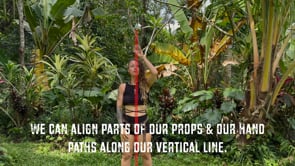
Overview of the vertical line concept in fan flow, using an imaginary centerline that splits the body in half and guiding prop or hand paths to trace along it.
Lesson • Flow • Fans • Horizontal Line
Lines: Horizontal
An overview of the horizontal line concept in fan flow, using a shoulder-height T-shaped arm line as a reference for moving from side to side and switching hands across the body.
Lesson • Flow • Fans • Diagonal Line
Lines: Diagonal
Diagonal line pathways for fan flow, using one or two 45-degree lines like an X. The lesson describes moving hand passes and prop paths along these diagonal tracks for double-prop symmetry and clean lines.
Lesson • Flow • Fans • Infinity Shape
Shapes: Infinity
Infinity Shape patterns with flow fans, focusing on continuous figure-eight pathways and shape control.
Lesson • Flow • Fans • Petal Shape
Shapes: Petals
Petals in fan flow are created by adding a spin at key points of a shape such as a diamond or box. The prop makes small looping arcs at the corners, forming a flower-like petal pattern for the audience.
Lesson • Flow • Fans • Hybrid Shape
Shapes: Hybrids
Hybrid shapes in fan flow, combining two basic shape paths into one continuous pattern, such as blending a circle with a diamond or mixing a figure eight with a box.
Module 3 - Timing & Direction
Lesson • Flow • Fans • Same Direction • Same Time
Same Time Same Direction
An introduction to the fans concept of same time, same direction, where both hands move simultaneously in the same direction. The pattern is shown traveling together to one side and mirrored to the other.
Lesson • Flow • Fans • Same Direction • Split Time
Split Time Same Direction
Split time, same direction fan spinning with both hands rotating the same way while staying out of phase. One fan reaches the top of the circle as the other reaches the bottom, repeating the 12 o’clock and 6 o’clock timing.
Lesson • Flow • Fans • Opposite Direction • Same Time
Same Time Opposite Direction
Same time opposite direction fan flow pattern where both arms move in the same timing while each fan circles in the opposite direction, with one hand tracing left and the other tracing right.
Lesson • Flow • Fans • Opposite Direction • Split Time
Split Time Opposite Direction
Split time opposite direction for flow fans, with the arms split away from each other while the hands move in opposing directions at the same time. The pattern can be performed in either direction.
Module 4 - Fundamentals of Footwork
Lesson • Flow • Fans • Weight Shifting • Footwork
Footwork: Weight Shifting
A simple footwork drill focused on shifting full body weight from right to left and back. It uses a bent-knee stance to feel one foot become light as the other carries weight, building steady side-to-side rhythm.