

















































Flowarts Teacher
Nick Woolsey
61
Lessons
10
Free Lessons
4
hours
Week / Phase 1
Lesson • Poi • Spinning
Welcome to the Poi Spinning Beginner Series!
Welcome introduction to a poi spinning course, outlining the focus on basic poi movement foundations and steady practice habits. It sets expectations for building skills step by step with both hands before combining patterns into full movements.
Lesson • Poi • Stretching • Posture
Important Theory on Warming Up, Stretching, posture, and your health
An overview of warming up, stretching, and posture for poi practice, focusing on staying healthy during physical movement. It highlights gentle full-body ranges of motion, relaxed shoulder mechanics, and avoiding strained positions that can lead to repetitive stress.
Lesson • Poi • Info
Directions, orientation, and how to follow these videos
How to set clear directions and body orientation for poi practice, using nearby reference points to stay consistent. The lesson explains choosing front, back, left, and right in your space and keeping poi spinning paths aligned with those directions.
Lesson • Poi • Info
The first thing you should do with your poi...
An introductory poi lesson on the first steps with a new set of poi, focusing on safe, playful exploration. It covers choosing a soft poi and freely swinging, tossing, and moving it around the body to get comfortable with basic handling.
Lesson • Poi • Info
The second thing you should do with your poi: Hit yourself, a lot
An overview of getting comfortable with poi by allowing gentle, controlled contact, using soft poi and relaxed spinning. The focus is on reducing fear and flinching by treating light taps as feedback while practicing common pathways and patterns.
Lesson • Poi • Info
Warming up while exploring the Modes of Movement
A poi warm-up that explores modes of movement through gentle joint and body mobility. The sequence includes shaking out, balance and range-of-motion work, then simple poi-style patterns like inwards and outwards movements on the wall plane, using same-time timing.
Lesson • Poi • Spinning • Plane
Swinging, spinning, and controlling the plane of one poi
Single poi practice focused on swinging and spinning while keeping the poi on a consistent plane. The lesson highlights feeling the poi’s weight, reversing direction smoothly, and guiding the movement track in front of the body on either side.
Lesson • Poi • Crossing
Crossing one poi forward
Crossing one poi forward while keeping a steady forward circle. The poi switches from the left side to the right side in front of the body, like moving between two tracks, while the spin direction stays the same even if it looks different from each side.
Lesson • Poi • Same Direction • Same Time • Turn
Same-direction same-time turns: high and low
Poi lesson on “same same” turns, keeping both poi moving in the same direction at the same time while rotating the body. It contrasts high and low turn levels and focuses on maintaining the turn pattern without crossing hands.
Lesson • Poi • Same Direction • Same Time • Turn
Same-direction same-time turns: poi down behind the shoulders
Poi same-direction, same-time turns with the poi swinging down behind the shoulders. The pattern passes both poi behind the back at shoulder level, then uses body turns to keep the timing and direction consistent as the swings travel side to side.
Lesson • Poi • Same Direction • Same Time • Turn
Same-direction same-time turns: poi up behind the hips
Poi same-direction, same-time turns that bring both poi up behind the hips. The pattern circles forward to lift behind the body, adds a turn at the top, then lets the hands drop to continue into backward timing while keeping the poi path behind the hips.
Lesson • Poi • Crossing
Crossing both poi together, forward and backward
Poi lesson on crossing both poi together in the same direction, moving forward and backward. It explores alternating which arm crosses over or under, including brief holds in the crossed “hug” position before returning to open spinning.
Lesson • Poi • Split Time • Crossing • 2 Beat • Weave
Crossing poi forward split-time (2-beat weaves)
Crossing poi forward split-time 2-beat weaves, using a right-lead pattern that switches between uncrossed and crossed arms. The poi pass near each foot in alternating beats, with the lead hand crossing over to carry the pattern across the body.
Lesson • Poi • Split Time • Crossing
Give backward split-time crossing a try
Poi practice exploring backward split-time with crossing patterns, switching the crossing direction to either side while staying in split time.
Lesson • Poi • Info
Using the world around you for poi feedback
Using poi practice, the lesson explores how nearby landmarks can give feedback on tracks and planes. It uses a narrow dock and fixed reference points to notice clean crossings, circle direction, and changes in stepping while staying aligned.
Week / Phase 2
Lesson • Poi • Posture • Poi Fu
Posture and Poi-Fu for Poi
An overview of posture and poi-fu body alignment for poi spinning, including standing tall with a long spine, gentle pelvic floor and core engagement, open chest, and relaxed shoulder placement. It also frames these ideas as a base for moving and turning safely while playing.
Lesson • Poi • Poitruvian • Poi Fu
Introducing Poi-Fu, starting with "Poitruvian Arms"
An introduction to Poi-Fu using “Poitruvian Arms,” practicing poi-style arm pathways without props. The lesson focuses on large, circular arm patterns around the head, sides, and legs, with attention to posture and clean body lines as a foundation for adding poi later.
Lesson • Poi • Same Direction • Split Time • Turn
Turning back-and-forth with arms circling split-time same-direction
Poi turning drill with arms circling in split-time, same-direction timing. The pattern pairs full-body turns with alternating forward and backward arm circles, keeping both hands moving in the same direction while rotating through the turn.
Lesson • Poi • Info
Circling your arms in opposite directions
Arm circles with one arm moving forward and the other backward, focusing on symmetrical opposite-direction motion. The pattern is practiced in the wall plane with relaxed shoulders and whole-body turning, as a foundation for poi movement control.
Lesson • Poi • Reverse • Stall
Stall and reverse #1 - Getting started
Introduction to poi stall-and-reverse basics, focusing on reversing one poi while the other continues spinning. The lesson emphasizes controlling each hand separately through simple stall-to-reverse actions and starting drills with one poi hanging while the other spins.
Lesson • Poi • Split Time • Butterfly • Plane
Bending planes, and split-time butterfly
Poi lesson on bending planes by moving the poi from wheel planes into closer, overlapping paths, then returning to forward rotation. It also introduces a split-time butterfly pattern, including inward and outward variations while maintaining clear plane control.
Lesson • Poi • Same Time • Turn
Smoothing out the same-time turns
Focuses on smoothing poi same-time turns by reducing unnecessary movement and keeping the pattern even and symmetrical. Uses body rotation and clear orientation cues to guide the turn while the arms stay relaxed, maintaining a consistent same-time turning plane.
Lesson • Poi • Same Time • Turn
Practicing all the variables of same-time turns
Same-time poi turns practice covering key direction and orientation variables, including clockwise and counterclockwise turning and left-to-right versus right-to-left movement. The lesson focuses on repeating the same-time turn pattern with different facing and foot placement.
Lesson • Poi • Butterfly • Same Time
Learning same-time butterfly, starting with the arms
Same-time butterfly for poi, with both hands turning together in opposite directions on overlapping planes. The pattern includes inward and outward variations, clear crossing in front, and changing which arm is on top to maintain spacing and avoid collisions.
Lesson • Poi • Butterfly • Same Time
Exploring same-time butterfly further
Further exploration of same-time poi butterfly, focusing on entering and exiting the overlap in forward wheel planes. The lesson highlights controlling spacing and hand height as the poi cross, gradually moving into butterfly and back out.
Lesson • Poi • 3 Beat • Weave
3-beat weave lead-up #2
A poi lead-up drill for the 3-beat weave, focusing on the alternating arm crossing pattern of right-on-top and left-on-top. It emphasizes keeping the motion in wheel planes and building a clear feeling for the overlapping cross timing before adding full weave beats.
Lesson • Poi • Info
Keep exploring freedom with one poi
Exploration of expressive one-poi spinning to build a strong foundation, focusing on freedom, musical play, and moving from the body’s center. Includes simple cross-forward and cross-backward ideas and ways to vary rhythm and movement with a single poi.
Lesson • Poi • Plane
If you are having trouble controlling your planes... find the Berlin Wall!
Using poi, this lesson focuses on controlling and maintaining a consistent plane, especially when reaching the hands backward in a forward split-time pattern. A wall is used as a visual reference to notice when the movement drifts out of plane.
Week / Phase 3
Lesson • Poi • Poitruvian
Practicing poitruvian arms
Poitruvian arm practice for poi, focusing on relaxed arm circles that pass the legs, rise toward the nose and ear, then reach behind the head. Emphasis stays on smooth arcs and steady posture while alternating right and left arms.
Lesson • Poi • Same Direction • Split Time • Poi Fu • Turn
Poi-fu: Turning with arms in split-time same-direction
Poi-fu turning pattern with both arms moving same-direction in split-time. The movement focuses on maintaining the poi-fu pathway while rotating the body through each turn, keeping consistent timing and orientation as you pass through a central position during the rotation.
Lesson • Poi • Reverse • Stall
Stall and reverse #2 - Getting smooth
Poi practice focusing on smooth stalls and reverses, cycling between right and left reversals with steady rhythm. The lesson centers on starting in forward spins, reversing one hand at a time, and returning to the start to repeat the pattern cleanly.
Lesson • Poi • Crossing
Crossing one poi front to back, over the head
Crossing drill with one poi, moving the head of the poi from front to back over the head. Focus is on maintaining a steady rhythm while guiding the spin through a consistent plane and committing to the crossing path as the hands travel behind the head.
Lesson • Poi • Same Time • Reel • Turn
Introducing Reels (Looping the same-time turns)
An introduction to poi reels by looping same-time turns into continuous patterns. The lesson references common reel pathways such as hip reels and shoulder reels, and how repeating same-time turns creates a steady turning rhythm.
Lesson • Poi • 2 Beat • Weave
Backward 2-beat weaves
A poi lesson on backward 2-beat weaves, focusing on the crossing pattern where one poi passes under while the other stays on top. It covers practicing each hand’s path and switching between left-under/right-over and right-under/left-over variations.
Lesson • Poi • Split Time • Turn
Split time turns in front
Split-time poi turns performed in front of the body, shifting from same-time turns into a split-time timing. The pattern moves through front and low positions as each hand alternates leading during the turn, setting up a backward split-time orientation.
Lesson • Poi • Info
Controlling poi with the arms crossed
Poi control drills with the arms crossed, focusing on staying comfortable in the crossed position. The lesson explores keeping clean planes while crossing with either hand on top, and practicing both same-time and split-time spins while moving in and out of the cross.
Lesson • Poi • Behind The Back
Getting cozy with the super important thumbs-inward-behind-the-back position
A poi lesson on the thumbs-inward behind-the-back hand position, focusing on keeping both thumbs pointing inward while making circles behind the body. It covers getting comfortable passing through this position during behind-the-back patterns.
Lesson • Poi • Split Time • Rhythm
Q&A: Developing backward split-time rhythm
Backward split-time poi rhythm, focusing on keeping clean opposing circles and a steady pulse. The lesson highlights maintaining a stable center and coordinating arms and shoulders so one side rises as the other falls in backward timing.
Week / Phase 4
Lesson • Poi • Same Direction • Split Time • Poi Fu • Opposite Direction
Practicing poi-fu: opposites and same direction split time
Poi-fu practice focusing on split-time same-direction and opposite-direction patterns, using a clear reference plane to keep clean circles. The lesson emphasizes maintaining consistent planes and smooth hand switches while working close to a wall or similar guide.
Lesson • Poi • Wall Plane • Reverse • Stall • Plane
Stall and reverse #3 - Wall plane
Poi stall-and-reverse patterns in the wall plane, using right and left hand timing. The lesson focuses on switching between spinning and side-to-side swings, with inwards and outwards directions and clockwise and counterclockwise variations.
Lesson • Poi • Chase The Sun • Reel
Practicing the reels and chase the sun
Poi practice focusing on reels and the Chase The Sun pattern, using small body shifts and head turns to keep the planes consistent. The lesson emphasizes repeating the loop smoothly and linking several repetitions in a row from a clear starting landmark.
Lesson • Poi • Poitruvian
Adding poi to poitrivian
Adds poi to the Poitruvian arm pattern, building from one hand to both for a clean, symmetrical pathway. Focuses on keeping the hands moving through a clear T shape and around the head while matching the same arm timing and shape with the poi.
Lesson • Poi • Split Time • Turn
Split-time turns behind
Split-time poi turns performed behind the back, focusing on coordinating alternating timing as the poi pass behind the hips and shoulders during the turn.


Lesson • Poi • Split Time • Butterfly
Further with split-time butterfly, inward and outward
Further variations on split-time butterfly with poi, focusing on inward and outward directions. The lesson explores keeping split-time opposites while changing circle size and plane tilt, using small wrist-led circles or larger arm-led circles.
Lesson • Poi • Info
Tips on not getting dizzy
Tips for reducing dizziness while turning during poi practice, using simple pivot-step footwork and controlled spinning. Focus is on keeping the head level on a consistent axis and using spotting-style attention to make stopping and changing direction feel steadier.
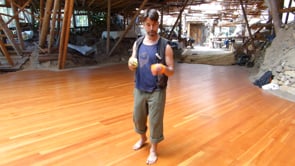
Lesson • Poi • Shuffle • Whirl
When to whirl and when to shuffle
Compares shuffle stepping and whirl-style pivot turns in poi practice, focusing on when to keep footwork simple and when to add turning patterns. Covers choosing between shuffling around and using more structured pivots while combining steps with poi movement.

Lesson • Poi • Info
Q&A: Answering a great question about crosspoints
A poi Q&A about crosspoints when both poi cross at the same time, explaining that one crosspoint sits higher than the other. It describes varying the height and spacing of the two crosspoints by raising one arm and lowering the other.