

















































Flowarts Teacher
Nick Woolsey
66
Lessons
5
Free Lessons
6.5
hours
Module 6
Lesson • Poi • Antispin • Turn
Turning with antispin with little buddha
Turning practice for poi antispin using a “little buddha” center reference, focusing on front focus points on two planes. The pattern shifts between sides while maintaining antispin orientation through the middle position during turns.
Lesson • Poi • Stall
Nicks favorite stall pattern
A poi stall pattern that alternates right and left stalls through key modes, including inwards and outwards Mexican wave stalls and clockwise and counterclockwise windmill stalls. The sequence links these stall positions in a repeating rhythm across both hands.
Lesson • Poi • Buzzsaw • UFO
Mastering buzzsaw - horizontal UFOs
Horizontal buzzsaw work in poi, focusing on clean overlapping hand circles and keeping the plane level like a tabletop. The lesson explores switching which arm is on top and connecting horizontal UFO-style circles with under-and-over threading.
Lesson • Poi • Spiral Wrap • Elbow
Lead ups to spiral wraps and elbow-wrist bounces
Poi drill sequence for lead-ins to spiral wraps, using elbow and wrist bounces. Focuses on keeping the poi in a controlled wall plane, with slight inward angle, to make consistent contact on the arms before moving into wrap entries.
Lesson • Poi • Mexican Wave • Opposite Direction
Crosspoints applied to alternating opposites
Poi lesson on applying crosspoints to the Mexican Wave pattern in opposite direction, focusing on keeping each shoulder reel crossing through consistent points on the side lines and adjusting the crossing position by changing arm height and plane.
Lesson • Poi • Orbing • Plane
Poi planes saloon doors and orbing
Poi plane work focusing on saloon doors in a wall plane, keeping spins aligned while tilting in and out. The lesson links these plane bends into orbing, moving the planes through a full circular range, with variations using matching or opposing tilts.
Lesson • Poi • Inspin • Whirl
Whirling with inspin wings YAY
Poi combination focusing on whirls with inspin wings, combining inspin timing with a whirling pattern on the wall plane. The sequence relates to opening into two whirls from a weave and shaping the poi to angle inward during the wing motion.
Lesson • Poi • Split Time
Split-time progression sequence
A poi split-time progression sequence linking same-direction patterns, moving from a forward weave into a 4x4 fountain, then turning weaves high-to-low, opening into a whirl, lockout variations, and finishing with crossers.
Lesson • Poi • Reel
The missing reels
A poi reel variation called “missing reels,” based on hip reels, where the usual front/back plane relationship flips at the bottom of the circles. The pattern highlights both poi passing together at the toes or together at the heels while maintaining the reel timing.
Module 7
Lesson • Poi • 3 Beat • Weave
3-beat weave with your feet step 1
Introduction to a poi 3-beat weave performed with the feet, starting by attaching the tether to the toe. The lesson focuses on making controlled circles outside the leg, then crossing the poi over and under the other foot to begin the basic weave pattern.
Lesson • Poi • Opposite Direction • Split Time • Poi Fu • Whirl
Poi fu - whirling with split time opposites
Poi fu whirling pattern using split-time opposites, with each hand moving in opposite directions on staggered timing. Focus is on keeping clean circles and clear cardinal points while turning between planes in a controlled, symmetrical way.
Lesson • Poi • Buzzsaw • Poi Fu • Plane • 3D
Poi fu - going 3D with buzzsaw planes
Poi fu exploration of buzzsaw patterns by adding multiple planes of motion, moving from a single buzzsaw plane into 3D. The lesson focuses on switching between planes at key points and varying direction and timing within the buzzsaw.
Lesson • Poi • Footwork • Safety • Turn
Footwork - more on knee safety when turning with friction
Footwork for safer turning on high-friction surfaces in poi practice, focusing on reducing knee strain. Covers stepping and closing patterns, weight shifts, and small bounce or micro-leap pivots to allow the foot to rotate without twisting the knee.
Lesson • Poi • Footwork • Turn
Footwork - more on turning on concrete continued
Poi footwork focused on turning on concrete, using step-and-pivot timing to change direction without twisting on the planted foot. It highlights letting the feet lead the body through weight shifts and comfortable forward and backward landings during turns.
Lesson • Poi • Weave
Playing with lockouts from weaves
Poi weave variations that add lockouts by briefly opening the arms into a freeze, then returning to the weave. The lesson explores placing lockouts on either side of the weave, including horizontal and vertical positions while keeping the weave rhythm.
Lesson • Poi • Corkscrew • 4 Beat
4-beat corkscrew
A poi 4-beat corkscrew pattern, extending the basic corkscrew by adding extra beats per cycle. The movement keeps a symmetrical, windmill-like milling structure, similar in timing to a 4-beat weave, and maintains the corkscrew pathway through repeated above-and-below passes.
Lesson • Poi • Behind The Back • Plane • Weave
Behind the back weave - planes and the space around you
Poi behind-the-back weave focused on plane control and awareness of the space around the body. The lesson highlights keeping the weave symmetrical, managing plane width and angle, and using visual reference lines to check alignment without looking down.
Lesson • Poi • Body tracing • 6 Beat
Body tracing 6-beat fountains
A poi sequence combining 6-beat fountains with body tracing, linking forward and reverse archer weaves. The pattern uses crossed wrists and sliding hand paths along the arms, moving between armpit, shoulder, and front positions while keeping the fountain rhythm.
Module 8
Lesson • Poi • Plane • Turn
Turning with controlled planes summary
Poi turning practice focused on maintaining controlled spinning planes during continuous turns. The pattern emphasizes keeping the poi aligned in a steady wall plane while rotating the body, reducing unwanted plane drift that can cause the poi to pull outward.
Lesson • Poi • Spinning • 5 Beat • Weave
Poi spinning lesson smoothing 5-beat weave
Poi spinning lesson on smoothing a 5-beat weave by keeping the pattern even and controlled. It focuses on making the five-beat wrap-around motion cleaner, with attention to consistent size and wrist positioning in the weave.
Lesson • Poi • Fountain • Rhythm • Weave • Turn
Rhythm of turning in weaves and fountain
Poi rhythm focus on timing when switching between 4x4 fountain and turning weaves. It compares their different turning counts and frames a simple counting approach using up on one side and down on the other to stay in time.
Lesson • Poi • Antispin • 4 petal • Flower
Making sure you can do 4 petal antispin flowers
Poi lesson on creating clean 4-petal antispin flowers, focusing on clear petals in each direction for consistent timing. It highlights avoiding accidental extra petals when switching between horizontal and vertical flower orientations.
Lesson • Poi • Fountain • 6 Beat
Adding tracing the body to 6-beat fountain
Poi lesson on adding body tracing to a 6-beat fountain pattern. It combines opposite-arm tracing with coiling and uncoiling around the body to create smooth horizontal traces, moving through key pathways over the shoulders and under the armpits.
Lesson • Poi • Airwrap
How air wraps and hyperloops can be understood as the same thing
An overview of poi air wraps and hyperloops, showing how hyperloops can be understood as variations of the same wrapping pattern. The lesson focuses on the relationship between wrap directions across sides and how the tether movement connects the two concepts.
Lesson • Poi • Split Time • Turn
Sky cam view of turning with split-time arms
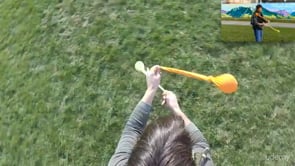
Sky-view look at turning while keeping poi in split-time opposites, showing how the body turn drives most of the motion while the arms stay small and consistent.
Module 9
Lesson • Poi • Spiral Wrap
Spiral wraps
Spiral wraps in poi, starting from split-time same-direction wall plane patterns and bringing the hands together to create a wrap around the hands. The lesson focuses on keeping a controlled plane while bouncing off opposite elbows and hands as a setup.
Lesson • Poi • Flower • 4 petal • 6 petal • 8 petal
Flowers - 4 6 8 petals
Overview of poi flower patterns with different petal counts, comparing 4-, 6-, and 8-petal flowers. The lesson focuses on how the number of petals changes the pathway and timing, using clear reference points like down, up, front, and back.
Lesson • Poi • Antispin • Extension
Antispin extension switchbacks
Antispin extension switchbacks for poi, focusing on switching between antispin and extension patterns. The movement cycles through repeated direction changes as the arms and poi pass through set positions, creating a steady switchback rhythm.
Lesson • Poi • Flower
Flowers in both hands
Two-poi flower patterns with a flower in each hand, focusing on four-petal flowers with clear cardinals. It covers combining forward and backward rotations between hands, coordinating arm direction, and switching the up-and-down timing while keeping both flowers aligned.
Lesson • Poi • Spinning • Flower • CAP
Horizontal-Poi-Spinning-CAPs-and-Flowers
Horizontal poi spinning patterns focusing on CAPs and flower shapes. The lesson explores combining extension with in-spin and anti-spin timing to keep the plane stable while changing rotation direction and creating clear, repeatable horizontal geometry.
Lesson • Poi • Info
Sky view leadups to hyperloops
Sky-view poi lead-up drills for building hyperloops, focusing on one-hand patterns. The lesson highlights crossing actions and alternating between outside-the-loop and through-the-loop pathways, using body turns and brief pauses to guide the poi’s path.
Lesson • Poi • Barrel Roll
Sky view hyperloops via barrel roll inversions
Poi lesson on sky-view hyperloops connected through barrel roll inversions. Focuses on keeping the hyperloop rotations symmetrical as each poi passes the center line, with options for single or multiple circles before releasing cleanly.
Module 10
Lesson • Poi • Whirl
Improving whirling in all the modes
Whirling with poi across the four timing and direction modes: same direction same time, same direction split time, opposite, and split time opposite. Focus is on keeping clean, controlled planes and adjusting the whirl angle and orientation while maintaining consistent movement.

Lesson • Poi • Matrix
Further with the Matrix
Continuation of the poi Matrix pattern, built from a four-beat corkscrew and wrap timing. Focus is on where the Matrix starts in the rotation, keeping a horizontal plane option, and maintaining alternating right-left beats as the poi travel around the body line.

Lesson • Poi • Opposite Direction • Split Time • Turn
Split time opposites inside the arms with turns
Poi split-time opposite-direction weaving inside the arms, combined with turning. The lesson focuses on keeping the opposites consistent while rotating the body, using inside-arm extensions and continuous turns.
Lesson • Poi • Spiral Wrap
More spiral wraps
More spiral wrap practice for poi, focusing on building a steady wrap rhythm and control. The lesson explores repeating spiral wraps in front of the body and above the head, with emphasis on consistent hand position and gradually increasing poi length.

Lesson • Poi • Spiral Wrap
Spiral wraps around one hand
Spiral wrap variation in poi where both poi wrap around a single hand, including options like a full-hand or two-finger wrap. The focus is on bringing both poi to one hand for a symmetric wrap and controlled release.

Lesson • Poi • CAP
More CAPs
Poi CAP patterns combining extensions and anti-spin pedals across different quadrants, forwards and backwards. The lesson explores building single and two-poi CAP combinations, including a classic CAP and a hybrid variation created by mixing extension and anti-spin actions.

Lesson • Poi • Opposite Direction • Flower • Turn
Turning in opposites flowers 2
Poi lesson on four-petal flowers in opposite directions while turning, including switching between neutral turns and turns to each shoulder. It focuses on coordinating opposite-direction flowers with body rotation so the pattern stays consistent during direction changes.
Lesson • Poi • Same Direction • Split Time • Flower • Turn
Turning with split-time same-direction flowers
Split-time, same-direction poi flowers combined with turning, focusing on keeping both heads spinning the same way while the body rotates. The pattern emphasizes consistent timing through neutral positions as the arms and poi swap forward and back during the turn.

Lesson • Poi • Body tracing • Fountain
Body tracing the 4x4 fountain
Poi body tracing variation on a 4x4 fountain, combining fountain timing with arm and head tracing pathways. The pattern traces under the armpit and around the head while maintaining the four-by-four fountain structure.

Lesson • Poi • Split Time • Same Time • Rhythm
Split time same time rhythm exploration with a friend
Partner poi rhythm exploration using split time and same time patterns. The lesson focuses on matching one hand in same time with a partner while the other hand stays in split time, and shifting between these relationships to keep a steady shared rhythm.